



 HOME
 By
Key Questions:
- What enables Türkiye to consistently produce successful game studios that compete on the global stage?
- From Peak Games to the “Founder Factory”: How can one successful studio give rise to dozens of new game companies?
- What lessons can Vietnamese game studios learn from Türkiye's gaming ecosystem?
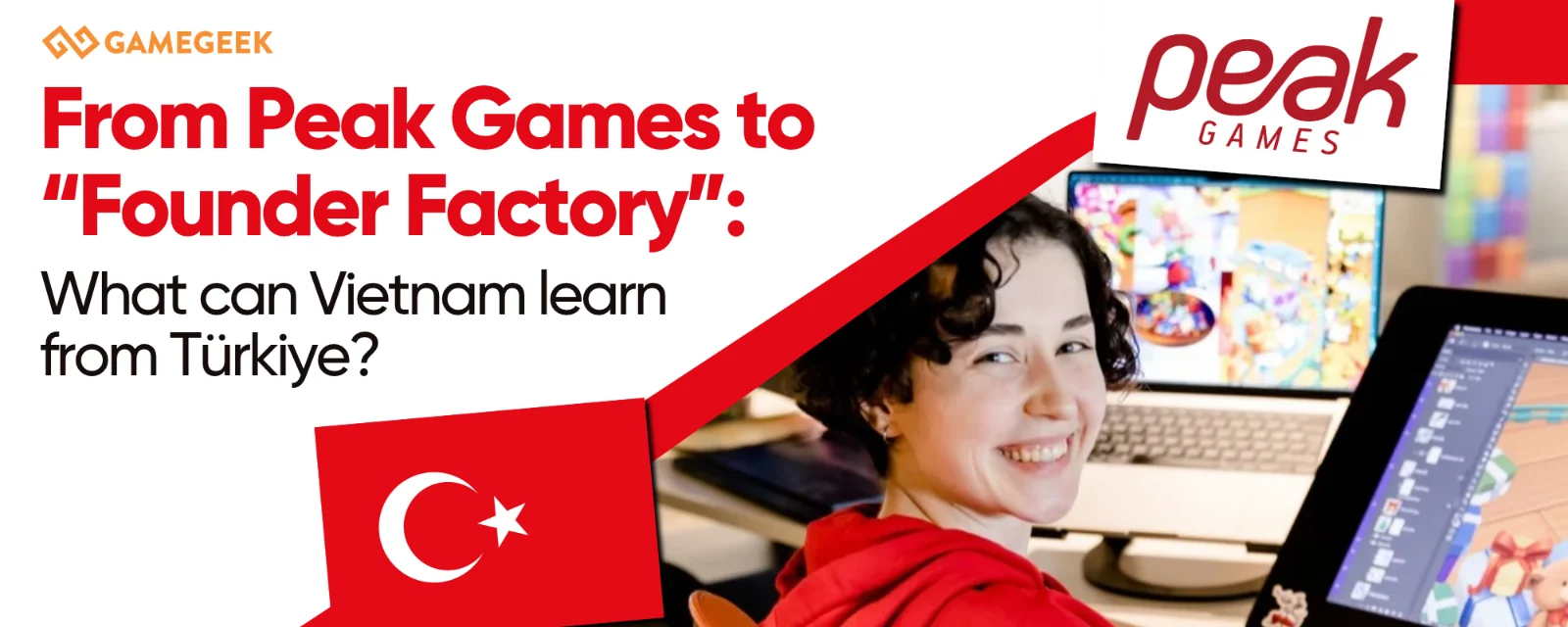
A successful game can put a studio on the global gaming map. But what is even more remarkable is when the people behind that success go on to establish new companies and develop more successful products. Türkiye is a prime example of this phenomenon, having built a mobile gaming ecosystem capable of consistently producing studios that compete on the global stage.
Behind names like Peak Games, Dream Games, and Rollic lies a combination of exceptional talent, successful companies that continuously produce new founders, and a highly supportive ecosystem. Vietnam is also beginning to show similar signs. The question is no longer just how to create a hit game, but how to continuously develop teams capable of building great games.
Peak Games: A Billion-Dollar Acquisition and Its Impact Beyond the Company
From a Doubted Vision to Türkiye's First Gaming Unicorn
When Sidar Şahin, the founder of Peak Games, set out to build a company in Türkiye with ambitions comparable to Google, many considered his vision unrealistic. Starting with card and board games, Peak eventually developed successful puzzle titles such as Toy Blast and Toon Blast.
In 2017, Zynga acquired Peak's card game business for approximately $100 million. Three years later, in 2020, Zynga acquired the remainder of the company for around $1.8 billion, making Peak Türkiye's first gaming unicorn.
More importantly, the acquisition demonstrated that a Turkish game studio could achieve success on an international scale, setting a precedent for future founders and changing how investors perceived the market.
From Peak Games to the “Founder Factory”: When Experience Multiplies
The ripple effect from Peak Games is far from an isolated case. According to The State of Turkish Gaming Ecosystem 2025, former Peak Games employees have founded 43 game studios, collectively attracting approximately $860 million in investment.
Former Gram Games employees have gone on to establish 18 studios, while alumni of Dream Games and Good Job Games have contributed to the creation of 8 and 5 new studios, respectively.
These figures demonstrate that experience does not have to remain within the company where it was originally gained. When professionals move between studios or establish their own businesses, the knowledge they have accumulated can continue to create value in new environments.
They bring with them a deeper understanding of prototyping, hypothesis testing, gameplay design, player behavior analysis, monetization optimization, and post-launch game operations.
This is the mechanism often referred to as the “Founder Factory”: successful companies become training grounds for the next generation of professionals capable of founding and leading new businesses.
More importantly, each new generation does not necessarily replicate the exact approaches of its predecessors. Instead, founders can build upon proven capabilities while developing new strategies suited to their own products and markets.
What Drives the Rapid Growth of Türkiye's Gaming Ecosystem?
A Founder Factory does not emerge automatically after a successful acquisition. For experience to translate into new companies, the ecosystem needs capable talent, environments where professionals can gain hands-on experience, and support systems that enable entrepreneurship.
From Universities to Game Studios: Developing Talent
On the education side, leading technical universities such as Middle East Technical University (METU) and Bilkent are widely recognized within the industry for contributing to Türkiye's gaming success by producing world-class graduates.
Beyond formal education, short-term training programs developed in collaboration with businesses have also played an important role. For example, a casual game development and game art bootcamp organized by Google, Patika, and Kodluyoruz helped connect participants with employment opportunities across 28 game companies.
On the business side, major studios actively compete for talent against some of the highest-paying industries.
According to Deconstructor of Fun, major exits have attracted talent from top universities and prestigious companies outside the gaming industry. Gaming has reportedly become the most desirable industry among recent graduates in Türkiye.
Gamigion reports that Dream Games offers more than $7,000 in monthly take-home pay for entry-level Product Specialist and Software Engineer positions, compared with a minimum wage of approximately $600.
The objective goes beyond recruitment. These studios are positioning gaming alongside finance and big tech as a leading career choice for top graduates from universities such as Koç, Sabancı, Boğaziçi, METU, and Bilkent.
Mobidictum also notes that gaming salaries in Türkiye have approached those in certain European markets, while companies such as Dream Games and Peak consistently attract outstanding graduates from the country's leading universities.
As a result, Türkiye's gaming ecosystem benefits from a combination of exceptional talent from top universities, a continuous pipeline of founders and startups, and a diverse, highly supportive network of industry stakeholders.
Together, these three factors create an exceptionally competitive market.
An Ecosystem That Supports the Next Generation
Türkiye has also developed a relatively mature network of businesses, investors, and supporting organizations.
The country currently has 13 incubators, 22 game-related accelerator programs, and 747 active gaming startups.
Universities develop talent, studios provide opportunities to gain practical experience, and investors and support programs create favorable conditions for new businesses to grow.
Successful exits also contribute to the emergence of new founders. Peak Games' $1.8 billion acquisition, for example, encouraged experienced professionals to establish their own companies.
In addition, the government provides substantial support for user acquisition costs, platform fees, and employee-related expenses. These initiatives give businesses additional resources to test products and acquire users during stages when commercial outcomes remain uncertain.
Türkiye's success, therefore, cannot be attributed to a single factor. It results from the combination of high-quality talent, studios capable of developing professionals through practical experience, founders who go on to establish new businesses, and an ecosystem that supports their growth.
When these elements work together, the success of one studio can evolve into a shared capability across the entire market.
Vietnam: Early Signs of a Similar Trend
Vietnam has yet to develop a clearly established Founder Factory ecosystem comparable to Türkiye's. However, early signs of this phenomenon are beginning to emerge.
As of 2026, an increasing number of new game companies in Vietnam have been founded by professionals who previously worked at successful domestic game studios.
Dino Games is one example. Its founding team includes former iKame executives, including Trương Ngọc Cường, the former CEO of iKame's gaming division, who established a new company in Hanoi alongside other former iKame leaders.
The founding team has previously contributed to products reaching more than 2 billion users, publishing over 200 games, and generating nine-figure revenues. Its development roadmap spans hybrid/IAP puzzle games, 3D racing and simulation, and midcore titles.
Gamigion has described this development as a potential “Peak Games moment” for Vietnam.
Other examples include HiGame, whose team includes former OneSoft employees; MOMIN GAMES, whose founder and CEO previously held COO and CTO positions at Minder Games; Doors Games, whose CEO previously worked at Bravestars; and Jurrac, which was also established by professionals with experience at Gapu.
These examples suggest that expertise accumulated within successful Vietnamese game studios is beginning to contribute to the emergence of a new generation of companies.
What Can Vietnam's Gaming Industry Learn from Türkiye's Success?
The most important lesson from Türkiye is not simply how to build a successful studio, but how the experience gained within that studio can continue to create value across new businesses.
For Vietnam, this process can begin with practical changes in talent development, product development, and knowledge sharing throughout the industry.
1. Learn Directly from Experienced Industry Professionals
Opportunities to connect with international markets are becoming increasingly accessible.
Industry conferences, accelerator programs, and publisher networking initiatives can help Vietnamese studios engage with professionals who have hands-on experience developing products for global audiences.
However, the greatest value comes when studios bring their own prototypes, retention data, advertising experiment results, or monetization challenges into discussions with experienced practitioners.
Through these exchanges, teams can gain more than advice on a specific issue. They can also understand how experienced professionals analyze problems, select relevant metrics, and determine the next steps for experimentation.
2. Build a Deeper Understanding of Game Development Principles Through GameGeek MasterClass
Learning from proven game mechanics is not inherently wrong. However, teams need to understand why those mechanics work, which player segments they serve, and where improvements can be made.
This is the approach promoted by GameGeek MasterClass, which focuses on developing a deeper understanding of fundamental principles and their practical applications rather than simply replicating successful games.
It represents a shift from following existing market trends to developing the capability to identify new product opportunities independently.
When professionals understand the underlying principles and know how to test hypotheses, their experience remains valuable even when they move into different game genres or business models.
3. Systematize Knowledge Within Organizations
Lessons learned from failed experiments, changes in monetization strategies, or decisions to discontinue projects should be documented alongside the context and reasoning behind those decisions.
This allows new team members to build on previous experiences rather than having to rediscover solutions or repeat the same mistakes.
It also helps prevent valuable institutional knowledge from being lost when employees leave or projects come to an end.
4. Create Opportunities for Experienced Professionals to Support the Next Generation
Founders and experienced industry professionals can contribute through mentorship, knowledge sharing, collaborative product development, and connections with publishers and investors.
These activities help emerging teams access practical experience more quickly while expanding professional networks across the industry.
Investment opportunities for Vietnamese game studios are also evolving. Panthera has completed a $1.5 million seed funding round with participation from CyberAgent Capital, while Garena Vietnam has recently announced a venture capital initiative dedicated to supporting domestic game studios.
Vietnam is already witnessing the emergence of new studios founded by professionals with experience at established gaming companies.
However, for these early developments to evolve into a sustainable, multi-generational model, the industry needs to help professionals deepen their expertise, enable businesses to preserve institutional knowledge, and create more opportunities for experienced leaders to support emerging talent.
Vietnam does not need to wait for a billion-dollar acquisition to begin this process. What matters is building the conditions that allow the success of one studio to become the foundation for the next generation of game developers and businesses.
References
- The State of Turkish Gaming Ecosystem 2025
- Replay Global Venture Builder – Istanbul Reflections: What Türkiye's Gaming Ecosystem Can Teach Us
- Gaming Industry in Türkiye Through the Lens of Education – ResearchGate
- PocketGamer.biz – Inside Türkiye's Fast-Rising Gaming Hub
- Tenjin – What Türkiye's Mobile Gaming Ecosystem Can Teach Us
- Mobidictum – Türkiye's Gaming Gold Rush: Can the Talent Keep Up?
- Mobidictum – Mobidictum Conference 2026 First Details
- Mobidictum – Mobidictum Mixer Hanoi 2026
- Gamigion – Salaries in Mobile Gaming Are Booming
- Gamigion – Ex-iKame Leaders Launch Dino Games
- Deconstructor of Fun – How Türkiye Became the New Capital of Mobile Gaming
- Duvar English – Turkey's Gaming Industry Attracts Investors
- Patika – Google Casual Game Bootcamp Case Study
- PocketGamer.biz – New Vietnam Mobile Studio MOMIN GAMES Launches
- SGPGrid – HiGame Studio
- Global Games Forum – Inside Vietnam's Next Generation of Game Studios
- LinkedIn – Funtap Games Joins GameGeek Accelerator 2026
- VnEconomy – Garena Vietnam Announces Venture Capital Initiative
- Deconstructor of Fun – Questions Istanbul Founders Stopped Asking
- Deconstructor of Fun – How Türkiye Became the New Capital of Mobile Gaming
- Deconstructor of Fun – Grand Games: From 0 to $500M in Two Years
- Deconstructor of Fun – Turkish Gaming Phenomenon Uncovered with Rina Onur
- YouTube – Inside Rollic's Playbook with CEO Burak Vardal